
Cold Chain Pharmacy Automation: How GLP-1s and Value Concentration are Redefining Pharmaceutical Distribution
Cold chain medications are changing how pharmacy leaders have traditionally thought about automation. While they don’t play as significant a role in terms of volume, they dominate in terms of risk.
In many central fill and specialty pharmacy operations, temperature-controlled medications represent a small share of overall volume but carry a disproportionate share of total value. That imbalance changes how operations and supply chain leaders should evaluate risk, labor, and system design. When a small number of SKUs drives a large portion of financial exposure, even minor breakdowns can have an outsized impact.
This is why, in today’s world, cold chain pharmacy automation is moving from a niche investment to a true operational priority.
Pressure That Goes Beyond Storage
Most pharmaceutical leaders have a strong handle on refrigerated storage. Controlled environments are generally well-monitored, validated, and well understood.
But cold chain performance is defined by more than just storage. It’s defined by what happens when products move from one location to another.
Every step in the process introduces potential risk, including retrieval from storage, staging between processes, manual handling during pacing, and transitions to outbound lanes.
In a central fill pharmacy automation environment, those steps are often tightly orchestrated to maximize efficiency. But as more temperature-sensitive therapies move through the system, those same steps become potential (and costly) failure points.
While the environment itself may maintain overall compliance, the real issue is whether control is maintained consistently from start to finish.
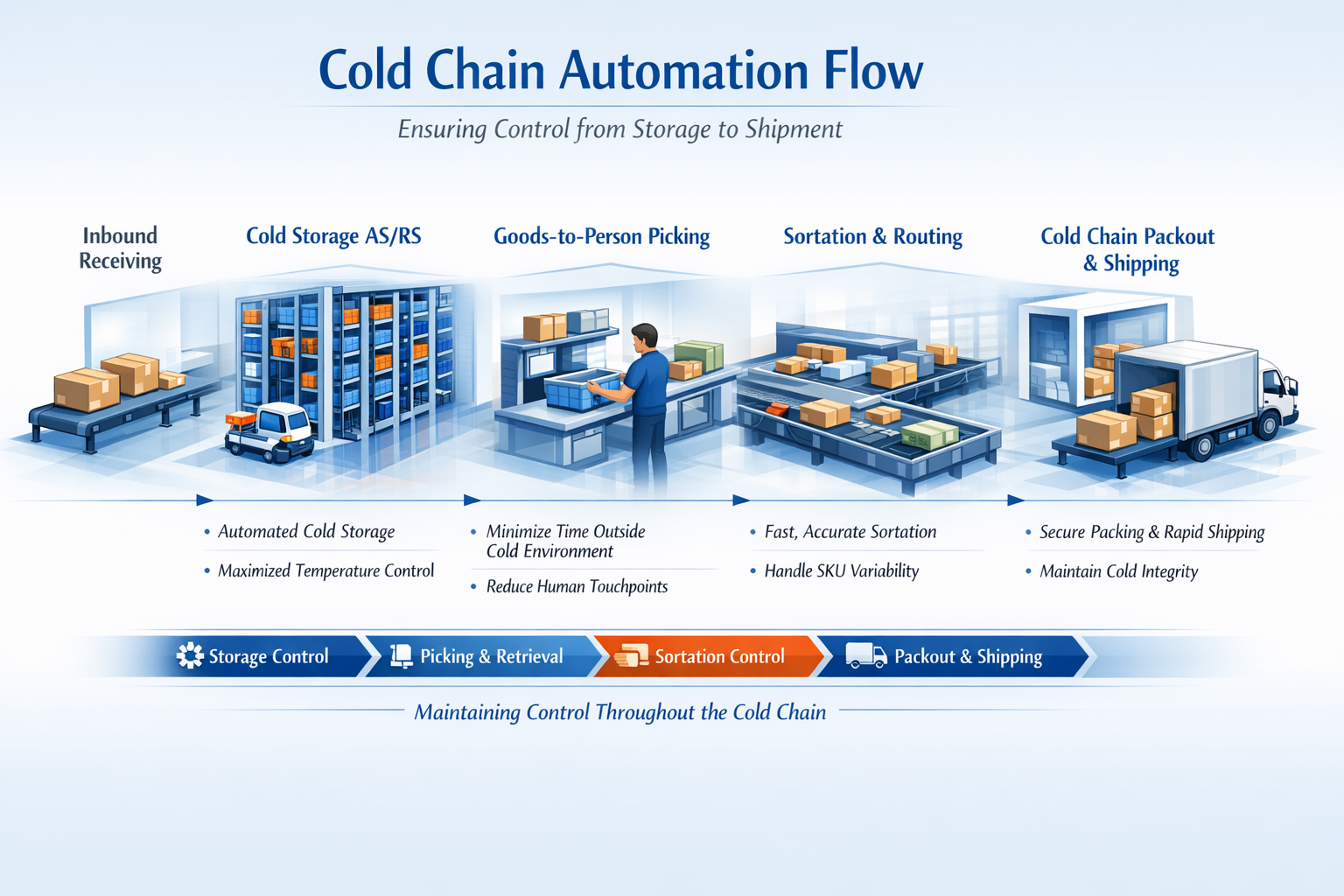
Example Cold Chain Automation Flow from Inbound to Outbound
Maintaining control and consistency across processes is key to success when handling high-value, sensitive products in cold chain environments.
Why Value Concentration Raises the Stakes
When high-value products, such as GLP-1s represent a small portion of volume, failures are not evenly distributed. A delay, an exception, or a temperature excursion does not broadly impact the system. It disproportionately affects the most valuable part of the inventory. That shifts how leaders should think about their operational performance.
Traditional metrics like throughput and labor efficiency, however, still matter. But in a specialty pharmacy cold chain environment, they are only part of the picture.
Pharmaceutical operations leaders also need to evaluate the following areas:
Where product waits between steps
Where manual handling increases under pressure
Where traceability becomes harder to maintain
How often exceptions disrupt the standard workflow
These are the points where pharmaceutical automation risk concentrates. In a high-value environment, reducing those moments directly impacts both cost and control.
“These are the points where pharmaceutical automation risk concentrates. In a high-value environment, reducing those moments directly impacts both cost and control.”
The Rise and Impact of GLP-1s in Pharmaceutical Operations
The rise of GLP-1 therapies has made these challenges even more visible. Demand has scaled rapidly, placing new pressure on storage capacity, fulfillment workflows, and packaging operations.
But the real impact shows up in the process itself. GLP-1 therapies demand careful attention and control throughout distribution and storage facilities. This includes:
Consistent 2–8°C temperature control
Careful handling across multiple steps
Frequent, recurring shipments to patients
Tight coordination between fulfillment and delivery
This is where the GLP-1 cold chain and GLP-1 warehouse automation become more of a stress test for existing infrastructure than traditional medications.
Workflows that were designed for more predictable prescription profiles can struggle when demand shifts this quickly. Volume increases, product variability increases, and process consistency becomes harder to maintain. While other industries deal with SKU and demand variety, they can manage it more effectively due to less demanding requirements for handling and distribution.
The result is not always a visible failure. More often, it shows up as slowly increasing challenges in the pharmaceutical automation process due to longer dwell times, more manual interventions, increased labor pressure, and higher exposure risk across workflows.
“While other industries deal with SKU and demand variety, they can manage it more effectively due to less demanding requirements for handling and distribution.”
The Importance of Pharmaceutical Serialization and Traceability
Cold chain risk extends beyond just the temperature of the facility or storage areas within it. It also includes the ability to track and verify the product at every step.
Under DSCSA requirements, pharmacies must maintain package-level traceability and ensure that every unit can be identified, verified, and tracked across the supply chain. That level of control depends on consistent, well-executed processes.
This is where DSCSA serialization intersects directly with cold chain execution.
If products are frequently staged, re-handled, or routed through inconsistent workflows, maintaining clean, continuous traceability becomes more difficult. Gaps in processes create risks not only to product integrity but also to audit readiness and compliance.
In other words, a cold chain workflow that relies heavily on manual intervention may meet basic requirements, but still carries unnecessary exposure.
Manual Handling in Pharmaceutical Distribution & Storage: Where Cost and Risk Meet
Manual handling is where cold chain performance begins to quietly break down, even in otherwise well-designed operations. Manual processes introduce small, persistent variations that become increasingly difficult to standardize at scale. Different operators develop slightly different rhythms. One may stage products immediately after retrieval, while another batches multiple orders before moving forward. During peak periods, staging areas fill faster than expected, and products sit longer while downstream processes catch up.
Exception handling adds another layer of complexity. Items are pulled out of the normal flow, forcing ad hoc decisions that were never part of the original process design. None of these moments appear critical on their own, and most are resolved quickly. But they rarely happen in isolation.
Over the course of a shift, those small inconsistencies begin to stack. A few extra minutes at retrieval, followed by a brief delay at packing, compounded by a slower handoff to outbound, creates a pattern of extended exposure that is difficult to see in real time. In a high-value cold chain environment, that accumulated time matters. It increases the likelihood that the product will spend longer than intended outside tightly controlled conditions while also introducing friction in serialized tracking and documentation.
A typical example shows how quickly this builds. In a specialty pharmacy that fulfills refrigerated injectables, a high-priority order is briefly picked and staged while awaiting verification. The delay is minor, but similar delays occur across dozens of orders. As pack-out stations become congested, operators begin prioritizing shipments out of sequence to keep volume moving. The system is still running, but the product is now sitting longer, being handled more frequently, and moving through a less predictable path.
For leaders responsible for performance and compliance, this is where the issue becomes tangible. Manual handling does not create immediate, visible failure. It creates a pattern of small inefficiencies and exposures that compound over time. In high-value cold chain operations, those incremental losses translate into higher labor costs, tighter compliance pressure, and greater operational risk than most systems were designed to handle.
What Pharmaceutical Leaders Should Solve First
Cold chain automation delivers the most value when it targets the right constraints.
For central fill and specialty pharmacy operations, that typically comes down to five priorities.
1. Reduce unnecessary touches
Each handoff introduces variability. High-value product should move through the process with minimal intervention.
2. Compress time between steps
Exposure risk increases when product waits. Reducing dwell time is one of the most effective ways to strengthen control.
3. Strengthen serialized process discipline
Traceability should remain intact from storage through shipment, without gaps between systems or workflows.
4. Design for product mix change
The growth of GLP-1 therapies is a reminder that product profiles can shift quickly. Systems need to handle variability without breaking process consistency.
5. Treat automation as a control strategy
Automation should reduce risk and stabilize execution, not just improve throughput.
What Better Cold Chain Automation Actually Looks Like
In practice, strong cold chain pharmacy automation is designed around control.
It allows operations to keep high-value products in a controlled environment until the exact moment they are needed, retrieve inventory in a predictable and repeatable way, reduce staging and unnecessary handling, maintain visibility and traceability at every step, and move orders through fulfillment without unnecessary delays.
That level of control typically starts at the source.
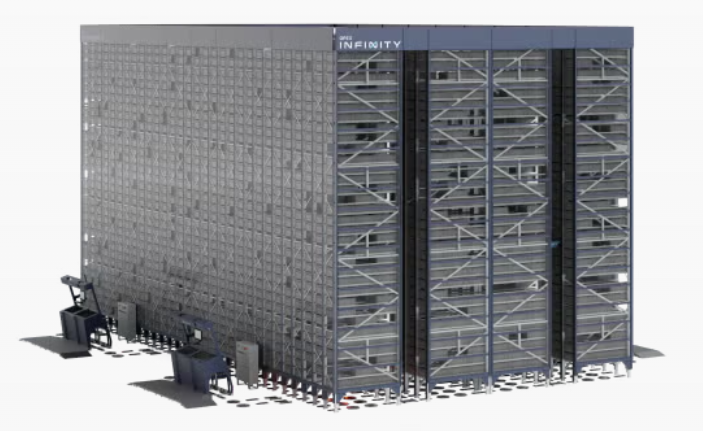
Systems like OPEX AS/RS bring a more disciplined approach to how temperature-sensitive products are stored and accessed. Instead of relying on frequent manual interaction inside controlled environments, inventory remains contained and is delivered to operators through a consistent, goods‑to‑person process. That changes the behavior of inventory. Retrieval becomes predictable, exposure is reduced, and the variability that often comes with manual access is removed from the equation.
From there, maintaining control depends on how the system handles movement.
As demand shifts and order profiles become more complex, the ability to move product without interruption becomes critical. This is where many operations begin to lose consistency. Product queues between steps, staging builds up, and operators step in to keep orders moving. Those moments create the longest delays and the highest exposure risk.
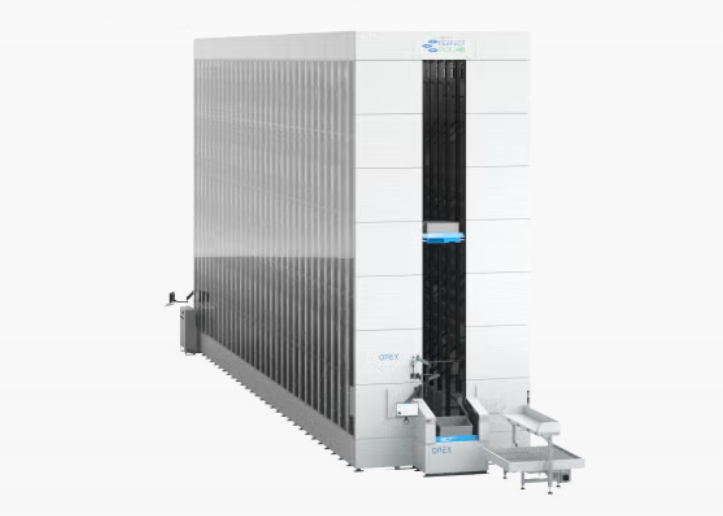
A system like OPEX SureSort helps stabilize this part of the process by maintaining order flow and sequencing without relying on manual intervention. Its ability to handle high volumes of small, variable items while keeping orders organized reduces the need for staging and minimizes the stop-and-go behavior that often defines cold chain risk. Instead of product waiting between steps, it continues moving in a controlled and deliberate way.
When these elements are aligned, the operation behaves differently.
Product stays in controlled conditions longer and only moves when the system is ready for it. Flow becomes predictable, even as volume and mix change. Manual handling is reduced at the points where variability has the greatest impact. Traceability holds through each transition because the process itself is consistent.
That is where automation delivers its real value in a cold chain pharmacy environment. It creates a system that maintains control under real operating conditions, rather than relying on people to recover it after variability has already been introduced.
The Real Question for Pharmacy Leaders
Cold chain fulfillment is becoming a larger strategic issue because the products moving through these operations are becoming more valuable, more sensitive, and more complex to manage.
The question is not whether your team understands cold chain requirements.
The question is whether your current infrastructure and workflow are aligned with the economic reality of those products.
When a small portion of prescription volume represents a disproportionate share of value, cold chain can no longer be treated as a secondary process. It needs to be designed as a core part of the operation.
That is where the right system design and the right level of automation make a meaningful difference.
“When a small portion of prescription volume represents a disproportionate share of value, cold chain can no longer be treated as a secondary process. It needs to be designed as a core part of the operation.”
Where to Start When Optimizing Automated Cold Chain Operations
Most cold chain challenges take time and effort to detect and diagnose. They tend to show up when issues arise that bring them to yoru attention, whether that’s lost or incomplete orders, increased overall wait times, and costly manual interventions that slow down delivery. Those moments are where risk builds and real root cause analysis can occur.
At Aegis Sortation, we work directly with pharmaceutical leaders to evaluate these realities inside their operations. We focus on how product actually moves, where control begins to slip, and what changes will have the most meaningful impact.
That includes:
Identifying where high-value product is exposed unnecessarily
Evaluating manual touchpoints and process variability
Reviewing how well systems support serialized tracking
Mapping how operations will handle continued growth in cold chain therapies
If you are evaluating your current operation or planning for what comes next, we offer a no-cost consultation to help you understand where your system stands today and what it will take to strengthen it.
No generic recommendations. No templated solutions. Just a focused conversation around your operation, your constraints, and how to build a system that performs under real-world conditions.
Reach out to us today to start the conversation and the next step of your cold chain automation and optimization journey.